Saturday, 22 March 2008
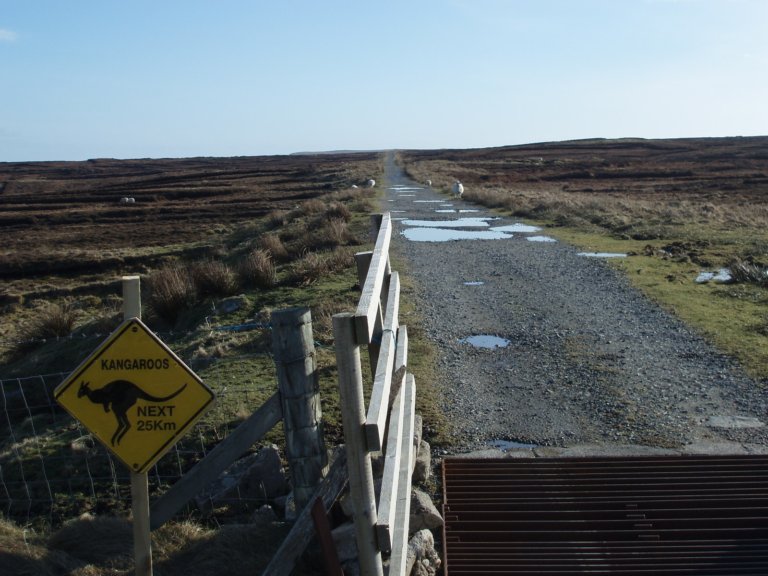
Warning sign
Earlier this month, as I showed on the blog, I went to Ness, where I found this roadsign. Nobody noticed it in the picture gallery, so I thought I'd blow it up.

Misplaced patient
The very sick man, who was dropped off on the wrong island, was taken home late yesterday afternoon by helicopter. It appears the pilot got himself confused because although the patient was going to Barra - he had understood his orders to be that he should taken him to the Uist & Barra hospital at Balivanich, on Benbecula. The man's medical condition meant he could not be taken home by road and ferry, which is the normal route from Benbecula to Barra.
Evening notes
Weather not as bad as could have been, although it has been wreaking havoc across the country. The lifeboat at Dunbar, east of Edinburgh, broke loose from its moorings and ended up washed onto rocks. It was later put back into water for assessment of any damage. Meanwhile, a fishing boat hailing from Ullapool found itself on the rocks on Friday night - they were also successfully refloated, if with quite a bit of damage.
Unrelated to the weather, apparently, was an accident just west of Fort William, where a car plunged into the Caledonian Canal at Banavie at 3.30 am this morning. Two people were found dead inside the car, once it was raised from the bottom of the canal.
South Africa is suffering a power crisis, but its neighbour Mozambique is coming to its aid. A hydro-electric scheme, involving a huge dam, is being upgraded, allowing increased exports of electricity to South Africa. Power shortages there are blamed on past lack of investment.
Saturday 22 March
A much better day than yesterday, with far less wind and (as yet) no rain or snow. We are due sleet and snow overnight, and temperatures will not exceed 6C today. The weather in northern England is reported to be atrocious, with high winds and heavy snow. The A66 route across the Pennines, between Scotch Corner and Penrith, is closed because of snow drifts. High waves swamped cars on the promenade at Redcar, east of Middlesbrough. Keep safe if you're down that way.
The far west of China was rocked by a 7.2 magnitude earthquake overnight. No reports of casualties of damage YET; the region is remote, wedged between Mongolia and Tadjikistan.
The far west of China was rocked by a 7.2 magnitude earthquake overnight. No reports of casualties of damage YET; the region is remote, wedged between Mongolia and Tadjikistan.
Friday, 21 March 2008
Good Friday

Today being Good Friday is a good occasion to bring up the recording I dug out for last year's Easter. The Matthaeus Passion by Bach is quint-essentially Easter. I recommend the recording of the final two chorals. Officially, you are not supposed to clap after a performance of this piece, which is after all related to the death of Christ.
If you have three hours to spare, here is the whole performance.
Sunny day?
Well, in between the hailshowers it looks nice. Went out to the shop earlier on, and was glad to accept a lift back. It's only a 5 minute walk, but not very nice in weather like this.
Although the sun may be shining, it is most definitely not doing so for a poor man from Barra. He went into hospital in Glasgow for radiotherapy, and was due to be flown home by helicopter. His condition is too poorly for him to travel by ferry and road. This morning, the helicopter landed on the wrong island, offloaded him, and took off again. The patient was taken to the Uist & Barra hospital in Balivanich, a few miles away - but 40 miles from home. He was due to have gone to St Brendan's Hospital in Castlebay, the main town in Barra. Weather conditions are too severe for the helicopter to come back, so he will have to stay in Balivanich for the time being.
Although the sun may be shining, it is most definitely not doing so for a poor man from Barra. He went into hospital in Glasgow for radiotherapy, and was due to be flown home by helicopter. His condition is too poorly for him to travel by ferry and road. This morning, the helicopter landed on the wrong island, offloaded him, and took off again. The patient was taken to the Uist & Barra hospital in Balivanich, a few miles away - but 40 miles from home. He was due to have gone to St Brendan's Hospital in Castlebay, the main town in Barra. Weather conditions are too severe for the helicopter to come back, so he will have to stay in Balivanich for the time being.
Friday 21 March
A superficially nice day, until you put your nose outside the door. A very cold northerly wind blows in occasional wintry showers, although not as heavy as last night. No ferry at all tonight; anyone wanting to leave or reach the island today has to travel through Harris and take a ferry to Uig in Skye.
A patient in hospital in Glasgow has been diagnosed with multiple-resistent tuberculosis. He arrived in the UK from Somalia, and was found to be suffering from the disease. This form of TB can only be treated with a cocktail of drugs, but the public are not at risk.
Generally, resistance to antibiotics has spiralled since their inception in the 1940s. It is a natural selection process, where bacteria who happen to have a genetic modification that allows them to survive antibiotics will proliferate. They are even capable of passing on the genetic information. Overuse of antibiotics (like for virus infections such as the common cold) has worsened the problem. TB is singularly difficult to treat, because the bug concerned has a chemical barrier around itself. For those versed in chemistry, its fatty acids run a length of 80 carbon atoms.
Thursday, 20 March 2008
Very springlike


Right, this is the first day of spring, and this is the view at 11pm this evening. Quite a heavy hail and snow shower. Far worse to come tomorrow, with a great deal of uncertainty over our ferry service.
125 years ago - paragraph 4191
Many more pages to go, but this was one of the most harrowing chapters I have come across as yet. It tells the story of the inhumanity visited upon the people on the western side of the Isle of Skye in the course of clearances.
4191. How many altogether were removed by Mr Gibbons?—Seventeen. He placed these families as close together as the sea would allow him; and we have but very little land, and it will not support us ; and some of those he took from Minginish were placed upon peat soil, which had never previously been cultivated. When he packed the people in that way Ebost tack was then free, and he thought that was a better bargain, and gave up Feorlick. Then Major M'Kinnon succeeded him. He was not very severe on the people. They were paying rent in work, but he removed some of the people,—Malcolm Stewart and Murdo Macdonald ; these had not a place on earth on which they could put a foot. I myself saw them living under a sail spread on three poles under high-water mark. He warned off Donald Campbell for giving shelter to a poor man who had not a place to live in. I saw the officer coming to his house and breaking into it; and he went in with a pad of water and extinguished the fire, and a great steam arose in the house; and what with the noise of the fire extinguishing and the denseness of the steam, his wife went out of her senses. We were then advised that if we would tow her after a boat in the sea, she would get better; and we took her out, and she would not sink deeper than up to her breast. I myself was two years in an asylum in Glasgow. I was a keeper there, and I never saw one that was so mad as her. Now Major M'Kinnon went to Edinburgh, and it was said he was brained there. He was succeeded by Mr John Scobie, who came to Harlosh, where I live. He told us freely that M'Leod of Dunvegan had overgiven to him, that he might do what he liked with us, and he said it was God who sent him there. He came and took a view of Harlosh, as the spies did who went to spy out the land of Canaan. There is a place there called Ardmore Point—a peninsula in Harlosh He thought that would make a splendid park for tups, and he thought that whatever became of the people, he would have such a park there, and he removed four of them, and said he would make them as comfortable up at Balmore as they were before. He said that he had told M'Leod about it, and that he had promised M'Leod he would make them as comfortable as they were before. The four people went up to see where they were to be located. There was a piece of mossy ground there, which had never been cultivated, and was in its primeval state, and when the people saw the place they would not go into it. John Campbell was one of them, John Macdonald was another, and they said they would trust to the providence of God; and if God should support them, they would go to Australia.
4191. How many altogether were removed by Mr Gibbons?—Seventeen. He placed these families as close together as the sea would allow him; and we have but very little land, and it will not support us ; and some of those he took from Minginish were placed upon peat soil, which had never previously been cultivated. When he packed the people in that way Ebost tack was then free, and he thought that was a better bargain, and gave up Feorlick. Then Major M'Kinnon succeeded him. He was not very severe on the people. They were paying rent in work, but he removed some of the people,—Malcolm Stewart and Murdo Macdonald ; these had not a place on earth on which they could put a foot. I myself saw them living under a sail spread on three poles under high-water mark. He warned off Donald Campbell for giving shelter to a poor man who had not a place to live in. I saw the officer coming to his house and breaking into it; and he went in with a pad of water and extinguished the fire, and a great steam arose in the house; and what with the noise of the fire extinguishing and the denseness of the steam, his wife went out of her senses. We were then advised that if we would tow her after a boat in the sea, she would get better; and we took her out, and she would not sink deeper than up to her breast. I myself was two years in an asylum in Glasgow. I was a keeper there, and I never saw one that was so mad as her. Now Major M'Kinnon went to Edinburgh, and it was said he was brained there. He was succeeded by Mr John Scobie, who came to Harlosh, where I live. He told us freely that M'Leod of Dunvegan had overgiven to him, that he might do what he liked with us, and he said it was God who sent him there. He came and took a view of Harlosh, as the spies did who went to spy out the land of Canaan. There is a place there called Ardmore Point—a peninsula in Harlosh He thought that would make a splendid park for tups, and he thought that whatever became of the people, he would have such a park there, and he removed four of them, and said he would make them as comfortable up at Balmore as they were before. He said that he had told M'Leod about it, and that he had promised M'Leod he would make them as comfortable as they were before. The four people went up to see where they were to be located. There was a piece of mossy ground there, which had never been cultivated, and was in its primeval state, and when the people saw the place they would not go into it. John Campbell was one of them, John Macdonald was another, and they said they would trust to the providence of God; and if God should support them, they would go to Australia.

Maundy Thursday
Today is the first day of the Easter weekend, it being Maundy Thursday. On this day, Christ called on his disciples to love each other, before washing their feet. Several centuries later, English monarchs would hand out Maundy alms on this day, the number of purses representing the monarch's age. This year, 82 purses to men and 82 to women. Each purse contains 82 pence, legal tender but specially minted for this day, so very rare. I once knew a man who received a purse of Maundy money.
Queen Elizabeth is in Northern Ireland for a three-day visit, and is attending Maundy Thursday service in St Patrick's Cathedral in Armagh. Read more here.
Queen Elizabeth is in Northern Ireland for a three-day visit, and is attending Maundy Thursday service in St Patrick's Cathedral in Armagh. Read more here.
Thursday 20 March
The first day of spring, but the weatherforecast predicts a return to winter. Today started bright and sunny, but with a strong northwesterly wind making it feel cold. Overnight, snowshowers will start to fall. Any lying snow will melt in the daytime, but will accumulate overnight.
A worker with toothache brought the Portree lifeboat in action overnight. He had been working on the island of Rona, just north of Raasay, when he developed severe toothache. The normal ferry could not manage in the bad weather, but the Portree lifeboat were happy to oblige, and took the man to the dentist.
A worker with toothache brought the Portree lifeboat in action overnight. He had been working on the island of Rona, just north of Raasay, when he developed severe toothache. The normal ferry could not manage in the bad weather, but the Portree lifeboat were happy to oblige, and took the man to the dentist.
Wednesday, 19 March 2008
Sunset
Sunset was some 10 minutes ago (as I start this post, at 6.45pm), and cloud has increased through the afternoon. Spits and spots of rain herald the advent of more of the wet stuff. Went for an amble about town this afternoon, and took the pics above. Regular readers may be familiar with some of the sights shown in them.
The parents of Madeleine McCann were awarded £550,000 in a libel case against two tabloid newspapers. These had alleged that they were responsible for Madeleine's death. The money was deposited in the Find Madeleine fund, and a front page apology printed. Since Madeleine went missing, nearly 11 months ago, her parents and a man named Robert Murat have been declared formal suspects by the Portuguese judiciary. Those are the only substantive developments. No trace of the 4-year old has been found since. I am sick of the tabloid press making up stories, and I restrict myself to skimming their headlines as pass by the newspaper stand in the shop.
Would you have confidence in a paper talking about "Macca" when referring to Sir Paul McCartney? His divorce settlement is another total non-story, except it showed his wife off in her true colours, by pouring a jug of water over her ex-husband's lawyer's head.
Wednesday 19 March
Fairly bright day, much the same as of late. We are warned against a wet and windy night to come, but that should clear away by morning. Yes, things are beginning to turn green, the grass shows signs of beginning to grow - otherwise, not very springlike. The birdfeeders will stay out until the leaves begin to grow.
A sure sign that the winter is drawing to a close is the change in the public transport timetables. Local buses and the regional ferry operator Caledonian MacBrayne all switch over on Friday 21 March, to a schedule with more services. In July and August, we even get three ferry sailings a day, as opposed to the two a day at other times. The first sailing is at 6.15 am, with others at 12.40 and 7pm; the ferry returns at 12.45 am (yep, after midnight).
Another sign is the arrival of the first set of tourists this season - after all, it is the Easter weekend coming up, which is normally when the season starts. In my first year, I remember travelling down the Harris road on a service bus at 10.30 am, when a perspired-looking cyclist came pedalling in the opposite direction, still some 22 miles short of Stornoway.
Tuesday, 18 March 2008
125 years ago
I continue to make my way through the many pages of the Napier Report of 1883, into the conditions of the people of the Highlands and Islands of Scotland. Paragraph 3596 gives a good example as to why the Napier Commission was brought into being, as many of the factors (proprietor's representatives) abused their position for their own gain - I think you could describe that as nepotism, as graphically described below.
15 May 1883
Statements prepared by the Tenants of Edinbane. Our lots are from 6 to 8 acres of arable land. There are about 20 half lots from subdivision. A large piece of the hill has been taken from us called Ben Dhu, and no compensation, given. Several of our lots have been taken down by 1 acre, and no reduction of rents. The proprietor has never done anything for the land. The houses are built and maintained by ourselves. On removal we get compensation for the roof only. We think our rents too high, when so much land has been taken from us, and the rent in many cases raised. They were last raised to give the factor Mr Robertson votes. We are not in arrears. Seven days' work is claimed by Mr Robertson from each lot, and 2s. is taken from us for every day we miss. He likes us to give him the first offer of stock, but he does not fix the prices. A lot is allowed four cows and twenty-four sheep. Four cows are too many for the pasture. The profits from sheep go direct to Mr Robertson for rent. We never touch a penny of the money. The money from our sheep for the rent, instead of being put in the bank for us until Martinmas -when it is due, is kept by Mr Robertson for his own use, and we get no interest from him for it. We cannot utilise fishing for the want of proper boats, &c. Fishing should be distinct from crofting. There were plenty of evictions in Grishornish and Coshletter before the time of the late Mr M'Leod. Many of us have seen the law officers come and strip the roofs in Edinbane, and pour water down on the fires. The people evicted mostly emigrated. They got no compensation. The land is now largely in the hands of Mr Robertson, the factor. We would migrate, not emigrate. No Gaelic is taught at our schooL We would like our children taught to read the Gaelic Bible. The school rates are a shilling. Fees for standard IILIs. 6d. There are eight paupers on the estate; most of these on Ben-Dhu have come from other places. Several cottars have been removed by the late Mr M'Leod and by Mr Robertson from Grishornish and Coshletter and put upon us. The poor-rates are 8d. Mr Robertson, the factor, has the lands once belonging to us of Kerrol and Ben-Dhu in his own hands. We received no reduction when these lands were taken from us. Mr Robertson keeps a meal-store, and we nearly all deal with him. We are this year already very deep in his books for meal. When Mr Robertson put the money on to our rents, for votes for himself as he said, he promised to make it good to us, but he has never done so, although we protest every year. We can give many other instances of oppression. One man took in a lodger against Mr Robertson's wish. He was fined a £1, and had to pay the £1 for five or six years, and was only pardoned last Martinmas. Another man for selling a stack of corn off the farm, although he had offered it to Mr Robertson several times, and was in sore need of ready money, was punished by having his rent raised from £3, 8s. 5d. to £4, which he still pays. The year before last two men quarreled about the march of their crofts. Mr Robertson ended the quarrel by fining the man with the largest croft 10s. a year on to his rent, and no corresponding reduction to the man with the small croft. In November last the factor put 7s. on to a half lot, with the reason stated, " I want to make a gentleman of you, and give you a vote." Mr Robertson has two shares of sheep in the hill, and although we complained, he will not pay for the grazing, and he refuses to let our sheep go over the lands of Kerrol, which is our right in winter, and makes us twice a year build up the dyke that keeps our own sheep out of our own grazings. We have to submit to such things as these, for fear of being evicted. Reforms wanted. More land and fixity of tenure. We cannot improve our lands at present as they will not support our families while we are improving them; but if we had enough of land to keep us on it the whole year round, and if we were made secure against fines and evictions from petty spite of the factor or other causes, we would improve it, and there would be no more heard of destitution in hard years like this. When the credit which this bad year drove us into is settled for, there will not be much of our stock left to us we think.
Windfarms
As I have remarked a few times in this blog, it has been proposed to build a huge windfarm on Lewis. The planning application is expected to be decided upon within weeks.
Yesterday, an Energy Conference was held in Stornoway, and the Energy Minister for Scotland said the Western Isles had excellent potential for renewable energy. Wind, tides, waves, solar, you name it. Sources which should be harnessed to the benefit of the community.
Our council is so determined to build a windfarm, come hell or high water, that they have already proposed an alternative, should the current proposal be turned down. More of the same, but now in the part-ownership of the community. One quote sent my head reeling: Generation on this scale will provide the additional benefit of being able to fund environmental management work that will enhance the sustainability of a wide range of habitats and support jobs for their interpretation.
The Energy minister announced at the end of January that he was "minded to reject" the current proposal, as it flies in the face of several European Union Habitat directives, related to protected species and habitats. If the current proposal is finally rejected, then so will the revamped proposal.
Army Cadets
Fourteen-year old Kaylee MacIntosh from Fyvie, Aberdeenshire, joined the Army Cadets with the aim of becoming a soldier. Her ambitions were not to be fulfilled, as she drowned whilst out on exercise with the Army Cadets in the Outer Hebrides last August.
On August 3rd, 2007, the weather was very poor, with an unseasonable force 7 wind lashing the Western Isles. The sea was whipped up by the strong winds, and local seamen stayed ashore that day. Nonetheless, three rigid-inflatable boats set out from South Uist into Loch Carnan, a sealoch on the island's east coast. One boat overturned.
A head-count was held, but a mistake was made, meaning it took about 45 minutes for someone to realise that Kaylee was missing. The emergency services searched for her, to find her underneath the upturned boat. Kaylee was flown to hospital in Stornoway, 60 miles away, but declared dead on arrival.
Today, the Marine Accidents Investigation Branch published a detailed report, (PDF file) which lists a catalogue of errors. The girl's parents may seek a prosecution, but that decision lies with the Procurator Fiscal in Stornoway. Mr and Mrs Macintosh feel that the Army has failed in its duty of care towards their daughter.
Tuesday 18 March
Another quite reasonable day, with the sun peeking through the clouds. Locally, we are still awaiting a decision on the North Lewis Windfarm, which would see 181 turbines, each standing 450 ft tall, marching 40 miles from Stornoway to Port of Ness via Bragar. The Energy Minister was in town yesterday, proclaiming the Western Isles should harness ALL forms of renewable energy. Some interpret this as a favourable hint towards the big project, other read it as its death knell.
Belgium has finally got itself a government, 9 months after general elections. It is a coalition of both Flemish- and French-speaking parties, from across the political spectrum. The language issue is not straddled by any political party, and the issue threatened to split the country in two. An intervention by King Albert II forestalled that. Thirty years ago, pitched battles were fought on the streets of the disputed district of Fourons-le-Comte / 's Gravenvoeren, south of the Dutch city of Maastricht, which threatened to spill across the Dutch border.
As the two names indicate, both language groups lay claim to it. Asking directions in Wallonia whilst speaking Flemish (note) will earn you a terse "comment?" (what?). People from the Netherlands, whose accent is different from the Flemish may get a response in their own language.
A man has appeared in court, charged with the abduction and illegal imprisonment of 9-year old Shannon Matthews. He was remanded in custody for another appearance at a later date. Shannon herself remains in the care of social services pending the conclusion of police inquiries.
Monday, 17 March 2008
War in Iraq
The war in Eye-rack is approaching its 5th anniversary. I'm feeling decidedly ambiguous about the whole project. I'll just give my take on it.
Saddam Hussein was America's own son of a b****. Following the Islamic revolution in Iraq's eastern neighbour Persia / Iran in 1979, the USA wanted an ally to prevent the spread of radical Islam across the Middle East. So they pumped Iraq's small-town dictator Saddam Hussein full of arms, and he fought a bloody war against Iran, which neither side won. In 1988, the war drew to a close, and Saddam Hussein decided to wage war on his own people, using nerve gas against the village of Halabja in the north of his country. During the 1980s, Mr Hussein had nuclear ambitions, but that was knocked out in an audicious airstrike by the Israeli airforce in 1981.
In August 1990, Saddam Hussein became a naughty boy by invading Kuweit, which Iraq regards as its 19th province. His troops overran the province in days, but after US forces amassed in Saudi Arabia and surrounding areas, the Iraqis were routed in short order some 7 months later. The road to Baghdad lay open, and American forces were 100 miles from the capital. They were ordered to halt their progress, at the behest of other Arab leaders. A decision which I personally reckon to have been a severe mistake.
In the following 12 years, Saddam Hussein continued to be a pain in the backside, but he was in a military stranglehold, and not an immediate threat to anybody's interests. Although he had used surface-to-surface Scud missiles during the 1990/1 war, the threat of chemical or biological weapons was never carried through. In fact, it is thought that in a flash of realism, Saddam has probably destroyed what stockpiles of nasties he held as his position became ever more restricted.
However, George W. Bush was now on the throne in the White House, and he got it in his head that he wanted to finish the jobthat his daddy had failed to complete in 1991. Furthermore, he blamed Saddam Hussein for complicity in 9/11, even though there was no evidence to support that accusation.
In 2003, the decision was taken to effect a regime change in Iraq, oust Saddam Hussein and the Iraqi people would warmly embrace their liberators, the American and British armies. The reason given was that Saddam held chemical, biological or nuclear weapons - without a shred of credible evidence. Afraid that UN inspection teams would back that up, troops were amassed and sent into Iraq on 19 March 2003.
Saddam Hussein was deposed within a month, and he hid in a hole in the ground, from which he was extracted in December 2003. Having stood trial, he was convicted of genocide and sentenced to death. His hanging, though deserved, was bereft of any dignity as the condemned man was taunted to his dying moment, and nearly decapitated in the process. Some would say he didn't deserve any dignity. It shows, in my book, greatness of character to grant dignity - if only to show the guilty party off as the real villain.
Having kicked Saddam out on April 9th, 2003, president Bush didn't have a proper plan beyond that. He showed a complete lack of insight into Middle Eastern politics of recent and more distant years, being totally unaware that many in the Middle East regard America as their arch enemy for their support for Israel, which (through its foundation in 1948) has usurped Arab lands and suppressed the Palestinians. If Mr Bush had shown insight - well, that's an empty line of reasoning. He rarely has in international politics.
So, the presence of American troops in an Arab state was a convenient rallying call for Al-Qa'eda, which sought to fill a power vacuum through an insurgency. Meanwhile, an Iraqi government was installed which was, if anything, weak. Fortunately, the Iraqis are getting fed up with all the Islamic hot-heads coming into their country, stirring up trouble that they don't want. Things are slowly, very slowly, improving. Suicide bombers still do their deadly work, and battles are still being fought in Iraq.
British and American forces will be in Iraq for years to come, to sort out the mess that their governments created. Mr Blair has left office in the UK, and Mr Brown will not be taking any really major foreign policy decisions before the next General Election in 2009. Mr Bush will be leaving the White House in January of that year. Their legacy will be slightly different from the one they may have had in mind upon ascending to office in 1997 and 2000 respectively.
The War in Iraq.
Evening notes
We didn't have a white Christmas, but we just might get a white Easter. The long-range forecast mentions temperatures of 4C on Easter Sunday. Great.
The mystery of famous French author Antoine de St Exupery, who disappeared whilst flying a mission during World War II, has apparently been solved. A former German fighter ace has come forward, admitting that he shot down St Exupery. He is famous for the story of The Little Prince, who lives on an asteroid.
The Princess Diana inquest has heard one more rumour that I don't care to hear about. Paul Burrell, former butler to the Princess, says he removed a blood-stained ring from Diana's finger after her death. Burrell himself has refused to give further evidence to the inquest. Want to know more? Read here.
Subscribe to:
Posts (Atom)